
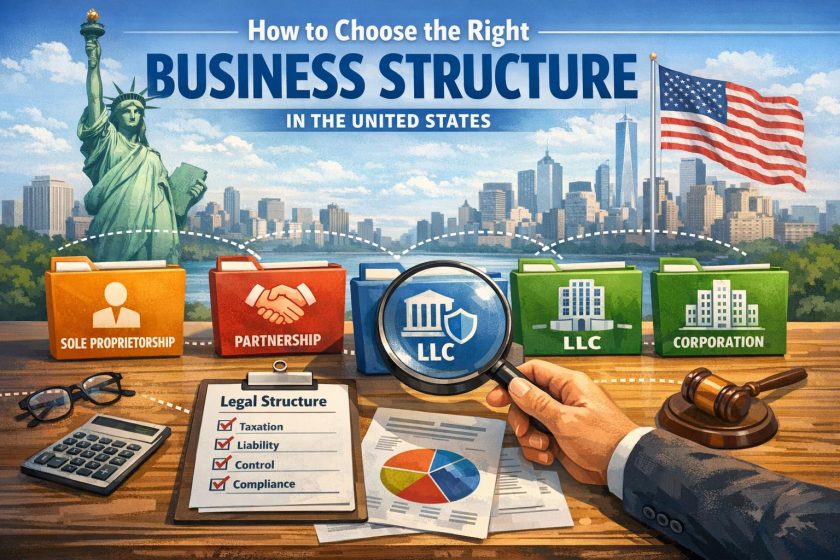
Choosing the right business structure is a critical decision for entrepreneurs starting a business in the United States. The structure selected at the outset will influence taxation, personal liability, governance, administrative obligations, and the ability to attract investors or transfer ownership. Because each business form is governed by a combination of state statutes and federal tax rules, understanding how these frameworks interact is essential. A carefully chosen structure can support operational efficiency and long-term stability, while an ill-suited one may result in unnecessary costs, compliance burdens, or avoidable risks.
Business structures determine how profits are taxed, how decisions are made, and how liabilities are allocated. They also shape relationships among founders, investors, employees, and regulators. While it is possible to change a company’s legal structure later, doing so may trigger tax consequences, regulatory filings, contractual renegotiations, and administrative complexity. For these reasons, a thorough assessment at the formation stage is advisable.
Common Business Structures
Several primary business structures are available under U.S. law. Each offers distinct advantages and trade-offs. The most common forms include the sole proprietorship, partnership, limited liability company (LLC), and corporation. These structures differ in how they treat ownership interests, allocate risk, and address governance requirements.
Sole Proprietorship
A sole proprietorship is the simplest and most direct way to conduct business. It exists automatically when an individual engages in commercial activity without forming a separate legal entity. There are generally no formal formation documents required beyond local permits and licenses, and income generated from the business is reported directly on the owner’s personal tax return.
This structure provides complete managerial control. The owner makes all decisions, retains all profits, and determines the strategic direction of the enterprise. For small-scale operations or professional services businesses with minimal risk exposure, this simplicity can be advantageous.
However, the defining characteristic of a sole proprietorship is unlimited personal liability. Because the business is not legally separate from the owner, personal assets such as savings, real estate, or other property may be used to satisfy business debts and legal judgments. If the business incurs significant obligations, enters into disputes, or faces regulatory penalties, the financial consequences can extend beyond the business itself.
From a tax perspective, profits are subject to individual income tax and self-employment tax. While the reporting process is straightforward, the entire net income of the business is treated as the owner’s income, regardless of whether funds are reinvested. This may affect overall tax planning.
Partnership
A partnership arises when two or more individuals or entities agree to carry on a business as co-owners for profit. Partnerships are governed by state law and by a partnership agreement, which sets forth the rights and responsibilities of the partners. While partnerships are relatively simple to form, a detailed agreement is essential to prevent disputes and clarify expectations.
Partnerships are generally pass-through entities for federal tax purposes. This means that the partnership itself does not pay income tax. Instead, profits and losses are allocated to partners based on the terms of the partnership agreement and are reported on their individual tax returns. This structure allows flexibility in allocating income among partners, provided allocations comply with tax regulations.
General Partnership
In a general partnership, all partners typically share responsibility for management and decision-making, unless otherwise specified in the partnership agreement. Each partner acts as an agent of the partnership and may bind the business through contracts or other commitments made within the scope of its operations.
A key feature of a general partnership is joint and several liability. Each partner is individually and collectively responsible for the obligations of the business. If one partner incurs a debt or legal liability in the course of partnership business, the other partners may be held personally accountable. This arrangement requires a high degree of trust and coordination among partners.
Despite this liability exposure, general partnerships can be effective for small groups of individuals who wish to combine expertise and resources without significant formalities. The ability to pool capital and share responsibilities may enhance operational capacity.
Limited Partnership
A limited partnership distinguishes between general partners and limited partners. General partners manage the business and assume personal liability for its obligations. Limited partners contribute capital and share in profits but typically do not participate in day-to-day management. Their liability is generally limited to the amount of their investment.
This structure is often used for investment-oriented ventures, such as real estate development or private equity funds, where passive investors seek limited liability and defined returns. To preserve their limited liability status, limited partners must avoid direct involvement in management decisions beyond specified protective rights.
Forming a limited partnership usually requires filing formal documents with the state. The partnership agreement typically provides detailed provisions regarding capital contributions, profit distributions, governance, and dissolution procedures.
Limited Liability Company (LLC)
An LLC combines elements of partnerships and corporations. It is a separate legal entity that provides limited liability protection to its owners, who are referred to as members. In most circumstances, members are not personally responsible for the debts or legal obligations of the company solely by virtue of ownership.
One of the primary advantages of an LLC is its flexibility. Members can choose between member-managed and manager-managed governance structures. In a member-managed LLC, all members participate in operational decisions. In a manager-managed LLC, designated managers oversee daily operations, which may be beneficial when some owners are passive investors.
For tax purposes, an LLC may be treated as a pass-through entity by default. A single-member LLC is typically disregarded as a separate entity for federal tax purposes, while a multi-member LLC is usually taxed as a partnership. However, LLCs may elect to be taxed as corporations if doing so aligns better with tax planning strategies.
This flexibility makes the LLC a popular choice among small and medium-sized businesses. It offers fewer formalities than a corporation, such as reduced requirements for annual meetings and record-keeping. Nevertheless, LLCs must maintain separate financial accounts and adhere to statutory obligations to preserve limited liability protection.
Corporation
A corporation is a distinct legal entity created by filing articles of incorporation with a state authority. It exists independently from its shareholders, meaning that it continues to exist even if ownership changes. Corporations may enter into contracts, own property, sue and be sued, and incur liabilities in their own name.
Corporate governance is structured around shareholders, a board of directors, and officers. Shareholders own shares of stock and elect directors. The board of directors sets overall policy and oversees management, while officers are responsible for day-to-day operations. This tiered structure enables clear allocation of authority and accountability.
Corporations are subject to more formal requirements than other business forms. These may include annual meetings, documented minutes, periodic filings, and adherence to statutory governance standards. However, these formalities can contribute to transparency and investor confidence.
C Corporation
A C Corporation is the default corporate tax classification. It pays corporate income tax on its profits. When profits are distributed to shareholders in the form of dividends, those dividends are taxed again at the shareholder level. This phenomenon, commonly referred to as double taxation, can influence decisions regarding reinvestment and compensation strategies.
Despite this tax structure, C Corporations are often preferred by businesses seeking substantial external investment. They may issue multiple classes of stock, grant stock options to employees, and attract venture capital or institutional investors. The corporate structure also facilitates public offerings, which are not available to most other entity types.
Because the corporation is a separate legal entity, shareholders’ liability is generally limited to the amount they invested. However, courts may “pierce the corporate veil” in cases of fraud or failure to maintain corporate formalities, imposing personal liability in exceptional circumstances.
S Corporation
An S Corporation is a corporation that elects a special tax status under federal law. It allows income, losses, deductions, and credits to flow through directly to shareholders, thereby avoiding corporate-level income tax. Shareholders report their share of the corporation’s income on their individual tax returns.
To qualify as an S Corporation, a company must meet specific requirements. These include limits on the number and type of shareholders, restrictions on issuing multiple classes of stock, and eligibility criteria regarding ownership. Because of these constraints, S Corporations are typically used by closely held businesses rather than companies seeking extensive external investment.
The S Corporation structure may provide tax planning benefits, particularly in managing compensation and distributions. However, compliance with eligibility rules is ongoing, and failure to meet requirements can result in termination of S status.
Factors to Consider
Selecting a business structure requires a comprehensive evaluation of legal, financial, and operational considerations. The appropriate choice depends on the nature of the business, its anticipated growth, the risk profile of its activities, and the preferences of its owners.
Liability
Liability exposure is often a primary consideration. Businesses operating in industries with higher risk of contractual disputes, regulatory scrutiny, or tort claims may benefit from structures that provide limited liability protection, such as LLCs and corporations. This protection generally shields personal assets from business-related obligations, provided that owners maintain proper separation between personal and business affairs.
In contrast, sole proprietorships and general partnerships expose owners to direct and potentially unlimited liability. While insurance may mitigate certain risks, insurance coverage has limits and exclusions. Evaluating potential exposure to creditors, customers, and other claimants is therefore essential when determining structure.
Taxation
Tax treatment varies significantly across business forms. Pass-through entities, including sole proprietorships, partnerships, LLCs taxed as partnerships, and S Corporations, allow income to flow directly to owners. This can simplify tax reporting and potentially reduce overall taxation in certain situations. However, owners must pay tax on allocated income even if profits are retained within the business.
C Corporations are subject to entity-level taxation, which may be advantageous in specific circumstances, such as retaining earnings for reinvestment or structuring employee benefits. The interplay between federal, state, and local tax regimes should be examined carefully, as state tax treatment may differ from federal rules.
Tax planning considerations may also include self-employment taxes, payroll taxes, and available deductions. Because tax laws evolve, ongoing consultation with qualified advisors is recommended.
Complexity and Administrative Requirements
Different structures entail varying levels of regulatory compliance and administrative effort. Sole proprietorships and general partnerships require minimal formalities, while corporations and some LLCs must adhere to more extensive record-keeping, reporting, and governance protocols.
Formal requirements can affect time management and operational costs. Preparing annual reports, maintaining meeting minutes, and complying with state filing obligations require attention to detail and may necessitate professional assistance. Entrepreneurs should assess their willingness to manage these obligations or delegate them to service providers.
Growth Potential and Capital Needs
The ability to raise capital is a significant factor for businesses planning expansion. Corporations, particularly C Corporations, offer the most flexibility in issuing equity to new investors. They may issue various classes of shares with distinct rights and preferences, which can accommodate complex financing arrangements.
LLCs also provide flexibility but may encounter structural limitations when dealing with certain institutional investors who prefer corporate stock. Partnerships and sole proprietorships generally rely on personal contributions, loans, or a limited pool of investors.
Long-term strategic plans, including potential mergers, acquisitions, or public offerings, should influence the initial selection of structure. Although conversion is possible, it may involve financial and legal consequences.
Continuity and Transferability
Continuity of existence differs among structures. Corporations have perpetual existence, meaning they continue regardless of changes in ownership. LLCs may also provide continuity depending on their operating agreements and state law. In contrast, sole proprietorships typically end upon the owner’s death or withdrawal.
Transferability of ownership interests can affect succession planning and investment strategy. Corporate shares are generally easier to transfer than partnership interests, which may require approval from other partners. Clear provisions addressing transfer rights contribute to organizational stability.
Additional Considerations
In addition to legal and financial elements, entrepreneurs should consider operational culture and governance preferences. Some founders prefer centralized control, while others value collaborative decision-making. The chosen structure should align with these preferences to support effective management.
Regulatory requirements may vary by industry. For example, professional service providers in certain states must form professional corporations or professional LLCs. Licensing boards and regulatory agencies may impose additional restrictions or mandates regarding ownership and governance.
State laws differ in formation fees, annual reporting requirements, and statutory protections. Selecting the state of formation can influence ongoing costs and compliance obligations, particularly for businesses operating in multiple jurisdictions.
Conclusion
Choosing the appropriate business structure in the United States is a foundational decision that shapes taxation, liability, governance, and growth opportunities. Each available form—sole proprietorship, partnership, LLC, C Corporation, or S Corporation—offers distinct characteristics and trade-offs. The optimal choice depends on a careful evaluation of risk tolerance, tax planning objectives, capital requirements, and long-term strategic goals.
Because legal and tax considerations can be complex and vary by circumstance, consulting legal and financial professionals is advisable before finalizing a structure. With thorough analysis and informed planning, entrepreneurs can select a business form that aligns with their objectives and provides a stable framework for sustainable operations.