
Understanding Sole Proprietorship
A sole proprietorship is the most straightforward and widely used form of business organization in the United States. It is an unincorporated business owned and operated by one individual. In this structure, the business and the owner are legally the same entity. There is no separate legal identity created by filing formation documents with the state, as is required for corporations or limited liability companies. Because of this simplicity, many entrepreneurs begin their commercial activities as sole proprietors, particularly in the early stages of a venture.
This business model is defined by the absence of a legal distinction between the owner and the enterprise. The owner is entitled to all profits generated by the business, but is also personally responsible for all debts, contractual obligations, and liabilities. The structure is commonly used for small retail operations, professional services, freelance work, consulting practices, and home-based enterprises. While it requires minimal formalities to begin operations, it still carries significant legal and financial implications that should be clearly understood before proceeding.
Legal Characteristics of a Sole Proprietorship
A sole proprietorship comes into existence automatically when an individual begins conducting business activities for profit without forming another recognized legal structure. There is no requirement to file articles of incorporation or organization to create it. The owner and the business are treated as one and the same for legal and tax purposes.
Because there is no separate legal entity, the owner holds title to all assets of the business in their personal name. Contracts entered into for the business are agreements between the owner and the other party. Debts incurred are personal obligations of the proprietor. If the business is sued, the owner is personally named in the lawsuit. Similarly, if the business owes money and cannot pay, creditors may pursue the owner’s personal assets, subject to applicable exemption laws.
The absence of separate legal status also means that the life of the business is tied directly to the life and decisions of the owner. If the owner ceases operations, retires, or passes away, the sole proprietorship ends unless steps are taken to transfer assets and continue operations in another legal form.
Advantages and Disadvantages
Advantages: The principal advantages of a sole proprietorship are ease of formation, direct control, and simplified tax treatment. Formation does not typically require formal registration with the state beyond local licenses or permits. The owner has complete authority over decision-making, including pricing, hiring, and strategic direction. Profits are not subject to separate corporate taxation. Instead, income and expenses are reported on the owner’s individual income tax return, avoiding the potential double taxation associated with certain corporate structures.
Administrative requirements are generally limited. There are no mandatory annual meetings, no board of directors, and no corporate record-keeping requirements imposed by statute. This simplicity reduces operational complexity and can reduce costs during the early stages of a business.
Disadvantages: The most significant disadvantage is unlimited personal liability. Because the owner and the business are legally indistinguishable, personal assets such as savings accounts, vehicles, and real property may be exposed to claims arising from business debts or legal judgments. This risk can be substantial in industries with higher exposure to contractual disputes or tort liability.
Another disadvantage is the potential difficulty in raising capital. Sole proprietors cannot issue stock or ownership interests to investors. Funding typically comes from personal savings, personal loans, lines of credit, or reinvested profits. Lenders may require personal guarantees, further reinforcing the exposure of personal assets.
Continuity is also limited. Since the business does not exist independently of the owner, succession planning can be more complex compared to entities that allow ownership interests to be transferred more easily. Additionally, some customers, vendors, or financial institutions may perceive incorporated entities as more stable or established, which can influence business relationships.
Distinction from Other Business Structures
It is important to distinguish a sole proprietorship from other common business forms. A limited liability company (LLC) and a corporation create separate legal entities that shield owners from personal liability for business debts, subject to certain exceptions. Partnerships, while also potentially unincorporated, involve two or more owners and may introduce shared liability.
In comparison, the sole proprietorship does not provide liability protection, does not require formal governance structures, and involves only one owner. The administrative simplicity and tax transparency make it accessible, but the trade-off is personal exposure to risk.
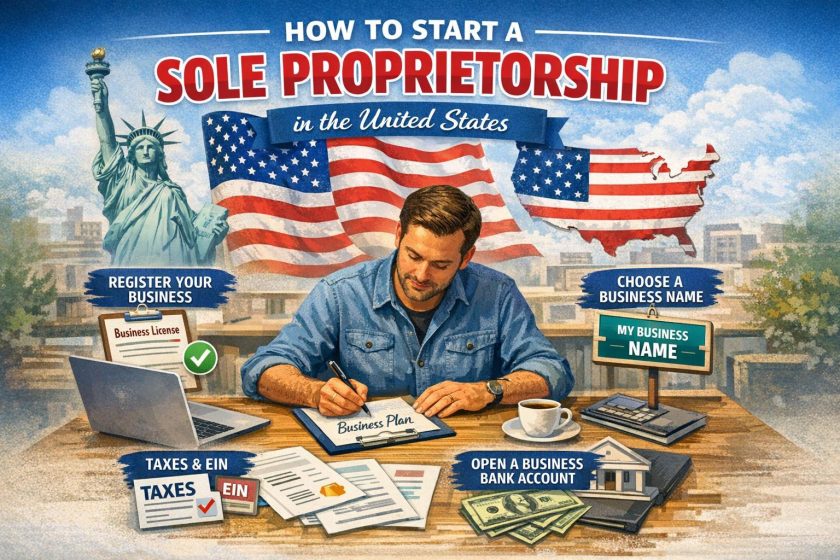
Steps to Start a Sole Proprietorship
Although a sole proprietorship can arise automatically when business activity begins, formalizing certain aspects of the operation is necessary to comply with state and local regulations. The precise requirements vary depending on location and industry.
Step 1: Choose a Business Name
Selecting a business name is typically the first formal step. An owner may operate under their personal legal name, such as “Jane Smith,” without additional registration beyond required licenses. However, many entrepreneurs prefer to operate under a trade name to distinguish the business identity from their personal identity.
If a trade name is used that does not include the owner’s full legal name, it is commonly referred to as a “Doing Business As” (DBA) or fictitious business name. Before adopting a name, it is advisable to verify that it is not already in use by another business within the same jurisdiction. State and county databases often provide searchable records. Conducting a name search reduces the risk of conflicts and potential trademark disputes.
Consideration should also be given to whether the chosen name may later be used if the business structure changes to an LLC or corporation. Checking availability across entity filings may help maintain consistency.
Step 2: Register Your Business Name
If operating under a DBA, registration is usually required by state or local authorities. The process often involves filing a form with the county clerk or Secretary of State and paying a filing fee. Some jurisdictions require publication of the fictitious name in a local newspaper for a specified period.
The purpose of registering a DBA is to provide transparency to the public regarding the identity of the person behind the business name. It does not create a separate legal entity, nor does it provide liability protection. Instead, it ensures that customers and creditors can identify the responsible party.
Once approved, the registered DBA may be used for contracts, marketing materials, signage, and banking purposes. Renewal requirements vary, and failure to maintain the registration may result in penalties.
Step 3: Obtain Necessary Licenses and Permits
Even though forming a sole proprietorship is simple, compliance with regulatory requirements remains necessary. Many businesses require local business licenses issued by a city or county government. Certain professions, such as contractors, real estate agents, healthcare providers, and cosmetologists, are subject to state-level licensing boards.
In addition to general business licenses, businesses may need zoning permits, health department permits, sales tax permits, or federal registrations, depending on their activities. For example, a restaurant would typically require health inspections and food handling permits. A business selling taxable goods must obtain a sales tax permit and collect applicable taxes from customers.
Failure to obtain required permits can result in fines, forced closure, or legal action. Therefore, reviewing local and state regulations before commencing operations is an important step.
Step 4: Set Up Financial Accounts
Although the law does not mandate a separate bank account for a sole proprietorship, establishing one is considered a sound financial practice. A dedicated business account simplifies bookkeeping, supports accurate record-keeping, and facilitates tax preparation.
Operating a business through a personal account can complicate the tracking of business expenses and income. Errors in record-keeping may increase the risk of inaccuracies in tax reporting. A separate account also enhances professional presentation when dealing with clients and vendors.
In addition to a business checking account, some proprietors establish a business savings account to set aside funds for estimated taxes or future expenses. Accounting software or professional bookkeeping services may further support financial management.
Step 5: Understand Tax Obligations
Taxation of a sole proprietorship is straightforward but requires careful record-keeping. The business itself does not pay income taxes as a separate entity. Instead, the owner reports business income and expenses on Schedule C, which is filed with their individual federal income tax return.
Net profit from the business is subject to ordinary income tax rates. In addition, sole proprietors must pay self-employment tax, which covers Social Security and Medicare contributions. Employers and employees in traditional employment arrangements share these taxes; in a sole proprietorship, the owner is responsible for the full amount.
Depending on the level of income, the proprietor may be required to make quarterly estimated tax payments to the Internal Revenue Service and, where applicable, to state tax authorities. Failure to make timely payments can result in penalties.
Record-keeping for tax purposes includes maintaining receipts, invoices, mileage logs, payroll documentation if employees are hired, and documentation of deductible expenses. Common deductions may include office expenses, supplies, equipment depreciation, and a portion of home office expenses if specific criteria are met.
Liability and Risk Management
Because unlimited personal liability is a defining characteristic of a sole proprietorship, managing risk is essential. One method of mitigating exposure is purchasing appropriate insurance coverage. General liability insurance may cover bodily injury or property damage claims. Professional liability insurance, also known as errors and omissions insurance, may protect service providers against claims of negligence or inadequate performance.
Property insurance can cover equipment and inventory, while commercial auto insurance may be required if vehicles are used for business purposes. Insurance does not eliminate liability but can provide financial resources to address claims.
Risk management also involves careful contract drafting, compliance with regulations, and maintaining accurate records. Written agreements with customers and suppliers should clearly define obligations, payment terms, and dispute resolution procedures.
Hiring Employees
A sole proprietor may hire employees, but doing so introduces additional legal responsibilities. The owner must obtain an Employer Identification Number (EIN) from the Internal Revenue Service if employees are hired. Payroll taxes must be withheld and remitted, and the proprietor must comply with federal and state labor laws.
Workers’ compensation insurance may be required depending on the number of employees and state regulations. The owner must also comply with wage and hour laws, anti-discrimination statutes, and workplace safety regulations. These obligations increase administrative complexity.
Alternatively, a proprietor may engage independent contractors. However, classification must be accurate under applicable laws. Misclassification can result in penalties and tax liabilities.
Financing Considerations
Financing a sole proprietorship typically relies on personal resources. Owners often use personal savings, borrow from family or friends, or apply for bank loans based on personal creditworthiness. Because there are no shares to offer, equity financing through investors is not available unless the structure changes.
Some lenders may offer small business loans specifically designed for sole proprietors. Approval often depends on credit history, collateral, and demonstrated revenue or projected cash flow. Personal guarantees are common, reinforcing the connection between personal and business finances.
Grants or government-backed loan programs may also be available, particularly for small or disadvantaged businesses. Thorough documentation of revenue, expenses, and business plans strengthens financing applications.
Record-Keeping and Operational Management
Maintaining organized financial and operational records supports both compliance and decision-making. Even in a simple structure, financial statements such as profit and loss statements and balance sheets provide valuable information regarding performance and sustainability.
Separate tracking of inventory, accounts receivable, and accounts payable assists in managing cash flow. For service providers, monitoring billable hours and project costs contributes to profitability analysis. Accurate records are also essential in the event of an audit or dispute.
Operational management in a sole proprietorship is centralized in the owner. This can streamline decision-making but may limit scalability if responsibilities exceed one individual’s capacity. Delegating tasks to employees or outsourcing certain functions, such as accounting or marketing, can improve efficiency.
Conversion to Another Business Structure
As a business grows, the limitations of a sole proprietorship may prompt consideration of conversion to another structure, such as an LLC or corporation. Reasons for transition may include increased liability exposure, the desire to bring in investors, or succession planning concerns.
Converting typically involves forming the new entity under state law and transferring assets and operations from the sole proprietorship to the newly established entity. Contracts, licenses, and permits may need to be updated to reflect the new legal structure. Professional legal and tax advice is often appropriate during this process to ensure compliance and evaluate potential tax consequences.
Further Considerations
While a sole proprietorship is the simplest business structure available, it should not be approached without careful analysis. The absence of formal filing requirements does not eliminate the need to understand compliance obligations. Licensing, taxation, employment laws, insurance needs, and contractual responsibilities all remain relevant.
Entrepreneurs considering this structure should evaluate the nature of their business activities, potential liability exposure, financial goals, and long-term plans. In some cases, the simplicity and cost-efficiency of a sole proprietorship make it appropriate, particularly for low-risk, small-scale operations. In other cases, the personal liability risks may outweigh the administrative advantages.
Consulting with legal, accounting, or business professionals can clarify the implications of operating as a sole proprietor. Proper planning at the outset supports regulatory compliance and operational stability. Although the structure is straightforward, thoughtful management and informed decision-making remain essential for sustainable business operations.