
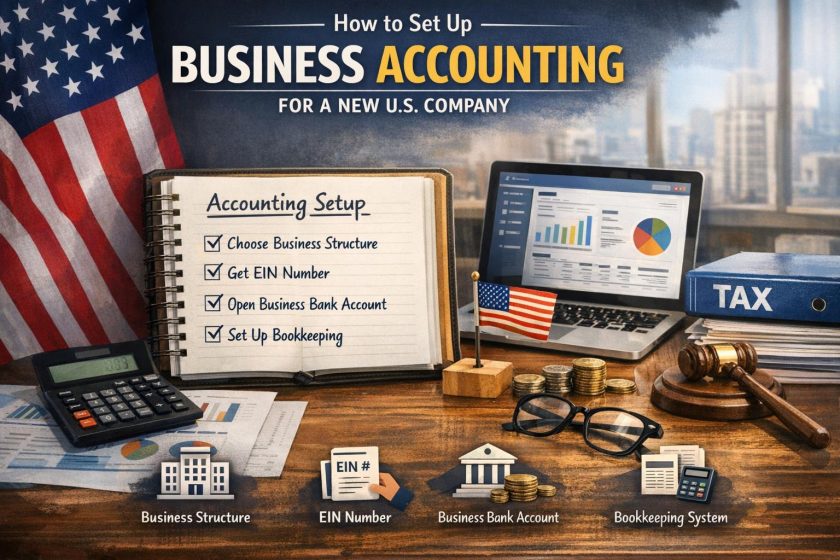
Establishing a Business Structure
Before setting up an accounting system, a business must determine its legal structure. The choice of structure affects taxation, reporting requirements, liability, ownership flexibility, and administrative responsibilities. Selecting the appropriate form at the outset reduces the need for restructuring later and creates a stable foundation for financial management.
In the United States, a sole proprietorship is the simplest structure. It is owned and operated by one individual, and from an accounting perspective, the business and the owner are closely linked. Income and expenses are reported directly on the owner’s personal tax return. Recordkeeping requirements are generally less complex, but the owner bears full personal liability for debts and obligations. Accounting systems for sole proprietors often focus on tracking income, deductible expenses, estimated tax payments, and cash flow management.
A partnership involves two or more individuals or entities conducting business together. Partnerships require more detailed accounting records because profit and loss must be allocated among partners according to the partnership agreement. Capital accounts for each partner must be tracked carefully, documenting contributions, distributions, and each partner’s share of income or loss. Partnerships file an informational tax return, and each partner receives documentation reflecting their share of the business activity.
A Limited Liability Company (LLC) offers flexibility in taxation and structure. An LLC may be taxed as a sole proprietorship, partnership, or corporation, depending on elections made with the Internal Revenue Service (IRS). From an accounting perspective, the chosen tax classification determines reporting obligations. LLCs must maintain separate financial records to preserve liability protection and demonstrate a clear distinction between personal and business activities.
A corporation is a separate legal entity owned by shareholders. Corporations have more extensive reporting and compliance requirements. They must maintain formal accounting records, prepare annual financial statements, and adhere to corporate governance standards. Corporations may be classified as C corporations or S corporations for federal tax purposes. C corporations pay corporate income tax, while S corporations pass income and losses through to shareholders. Each structure requires precise accounting procedures to comply with federal and state reporting standards.
Choosing a business structure should involve consideration of growth plans, investor expectations, reporting complexity, and tax strategy. Consultation with legal and financial professionals ensures the structure aligns with operational and financial objectives.
Obtaining an Employer Identification Number (EIN)
An Employer Identification Number (EIN) is a federal tax identification number issued by the IRS. Most businesses require an EIN regardless of whether they have employees. This identifier is used when filing federal tax returns, submitting payroll tax reports, and communicating with tax authorities. Financial institutions typically require an EIN to open business accounts, and vendors may request it for reporting payments.
The application process is conducted through the IRS, and approval is generally immediate when completed online. Once assigned, the EIN becomes a permanent identifier for the business entity. Proper storage of EIN documentation is important because it is frequently needed for compliance, banking, and contractual purposes.
Obtaining an EIN early in the formation process supports organized recordkeeping. It ensures that tax documents, payroll filings, and financial accounts are accurately associated with the business. Using the EIN consistently across financial systems helps prevent discrepancies and simplifies audits or verifications.
Opening a Business Bank Account
Separating personal and business finances is a fundamental accounting principle. Opening a dedicated business bank account establishes a clear boundary between the owner’s personal expenditures and business transactions. This separation improves the accuracy of financial reporting and simplifies tax preparation.
When selecting a financial institution, businesses should evaluate fee structures, minimum balance requirements, electronic banking capabilities, and integration with accounting software. Many banks offer specialized services for small businesses, including merchant services, credit card processing, and payroll solutions.
A business may require multiple accounts, such as a checking account for daily transactions, a savings account for reserves, and potentially a merchant account for processing customer payments. Clear categorization of deposits and withdrawals within the accounting system depends on organized bank records.
Reconciling bank statements on a monthly basis is an essential practice. Reconciliation involves comparing the bank statement to internal financial records to ensure that all transactions are accurately recorded. This process identifies discrepancies such as duplicate entries, unauthorized transactions, or recording errors.
Maintaining disciplined cash management through a dedicated account enhances transparency and strengthens the reliability of financial statements.
Selecting an Accounting Method
The choice between cash basis and accrual basis accounting influences how financial performance is measured and reported. The selected method determines when income and expenses appear in financial statements and tax filings.
Under cash basis accounting, revenue is recorded when payment is received, and expenses are recorded when payments are made. This method focuses on cash flow and is often suitable for smaller businesses with straightforward operations. It provides a direct view of available funds but may not reflect obligations or receivables that have not yet been paid.
Under accrual basis accounting, revenue is recognized when earned, and expenses are recognized when incurred, regardless of cash movement. This approach aligns income with the related expenses, offering a more comprehensive view of profitability. Businesses with inventory, significant accounts receivable, or external reporting obligations often use accrual accounting.
Certain businesses are required by the IRS to use accrual accounting, particularly those exceeding specific revenue thresholds or maintaining inventory. The decision should account for regulatory requirements, investor expectations, and the complexity of operations.
Changing accounting methods after establishment may require IRS approval and adjustments to financial statements. Careful evaluation at the outset reduces administrative burden later.
Choosing Accounting Software
Modern accounting systems rely heavily on software solutions designed to automate and organize financial processes. Selecting appropriate software depends on the size of the business, industry requirements, transaction volume, and anticipated growth.
Many platforms provide core features such as invoicing, expense tracking, bank reconciliation, payroll integration, and financial reporting. Scalability is an important factor. Software should accommodate expansion in transaction volume, additional users, and advanced reporting needs without requiring a complete system replacement.
Ease of use affects consistency and accuracy. An intuitive interface reduces training time and minimizes entry errors. Security measures, including data encryption and user access controls, protect sensitive financial information.
Cloud-based systems allow remote access and automatic updates, while desktop systems may offer more localized control. Integration capabilities are also significant. Accounting software often connects with payment processors, inventory management systems, and tax preparation tools. Seamless integration reduces manual data entry and enhances real-time visibility into financial performance.
Testing software through trial periods supports informed decision-making. During evaluation, attention should be given to reporting flexibility, customization options, and support services.
Setting Up a Chart of Accounts
The Chart of Accounts (COA) serves as the structural framework of an accounting system. It organizes all financial transactions into standardized categories, enabling consistent recording and reporting.
Accounts are typically grouped into assets, liabilities, equity, revenues, and expenses. Assets may include cash, accounts receivable, inventory, and equipment. Liabilities could consist of accounts payable, loans, and accrued expenses. Equity represents ownership interest, while revenues and expenses reflect operational performance.
Customizing the COA to reflect the specific nature of the business enhances clarity. For example, a service-based company may emphasize labor-related expenses, while a retail business requires detailed inventory and cost-of-goods-sold accounts. Overly broad categories limit analytical usefulness, while excessive detail can create administrative complexity. A balanced approach ensures meaningful reporting without unnecessary fragmentation.
Consistent account numbering supports organization and scalability. Industry standards may influence account structure, particularly when external reporting or benchmarking is required.
Periodic review of the COA ensures it remains aligned with operational changes. When new revenue streams or expense categories emerge, the chart should be updated to maintain accurate classification.
Implementing Internal Controls
Internal controls are policies and procedures designed to safeguard assets, promote accurate reporting, and ensure compliance with regulations. Even small businesses benefit from establishing basic controls early in their operations.
Separation of duties is a fundamental control principle. Responsibilities for authorizing transactions, recording them, and handling related assets should be distributed among different individuals when possible. In smaller organizations where full separation is impractical, oversight mechanisms such as owner review of bank statements can mitigate risk.
Authorization procedures define who may approve expenditures or contracts. Documented approval thresholds create consistency and accountability. Secure storage of financial documents, both physical and digital, protects against unauthorized access.
Regular reconciliations and periodic internal reviews verify the accuracy of records. Comparing accounting data with supporting documentation, such as invoices and receipts, ensures completeness. External audits, while not required for all businesses, provide independent verification of financial statements.
Establishing written policies clarifies expectations and reduces ambiguity. As the business grows, internal controls should evolve to address increased transaction volume and complexity.
Recording Initial Transactions
Once the accounting system is configured, the first entries establish the starting financial position of the business. These initial transactions often include capital contributions, asset purchases, loan agreements, and initial expenses.
Capital contributions are recorded in equity accounts, reflecting the owner’s or shareholders’ investment. If the business begins operations with loans, those obligations must be recorded as liabilities, with clear terms regarding repayment and interest.
Accurate documentation supports each transaction. Invoices, bank statements, contracts, and receipts provide evidence for financial entries. Maintaining organized records facilitates audits and tax preparation.
Consistency in recording transactions ensures reliable financial statements. Revenue should be categorized correctly, expenses assigned to appropriate accounts, and supporting documentation retained systematically. Delayed recording increases the risk of omissions and reduces the usefulness of financial data.
Financial reports generated after initial postings, such as the balance sheet and income statement, provide insight into the company’s early financial status. Reviewing these reports periodically allows management to identify discrepancies and confirm that the system functions as intended.
Consulting with an Accountant
Although many accounting tasks can be managed with modern software, professional guidance remains valuable. Accountants provide expertise in tax regulations, reporting standards, and financial planning.
An accountant can assist in selecting an appropriate accounting method, structuring the chart of accounts, and ensuring compliance with federal, state, and local requirements. They also support preparation of tax returns, payroll filings, and financial statements. For businesses seeking external financing, professionally prepared statements enhance credibility.
Beyond compliance, accountants contribute to financial analysis and strategic planning. They may evaluate cost structures, advise on budgeting processes, and identify opportunities for operational efficiency. As regulatory requirements evolve, professional oversight reduces the likelihood of noncompliance.
Establishing a relationship with an accountant early in the business lifecycle allows for proactive planning rather than reactive correction. Periodic consultations ensure the accounting system adapts to growth, structural changes, and shifting regulatory standards.
A well-structured accounting framework supports accurate reporting, informed decision-making, and regulatory compliance. By systematically addressing legal structure, tax identification, financial segregation, recordkeeping methods, software implementation, internal controls, and professional consultation, a business creates a foundation for sustainable financial management.