
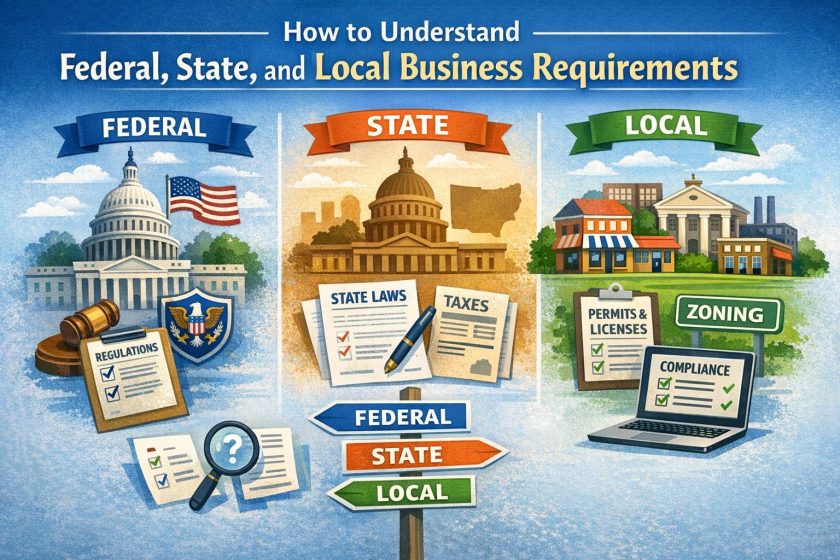
Understanding federal, state, and local business requirements is crucial for entrepreneurs and business owners to ensure compliance and avoid legal issues. Navigating the intricacies of business regulations can be challenging, but a structured approach simplifies this process. Every business in the United States operates within a layered legal framework in which different levels of government impose distinct yet interconnected obligations. These obligations affect how a company is formed, how it hires employees, how it reports income, how it markets products, and even where it may physically operate. A thorough understanding of these requirements enables business owners to reduce risk, allocate resources efficiently, and establish internal systems that support long-term operational stability.
While regulatory compliance may initially appear burdensome, it serves essential public purposes, including consumer protection, fair competition, workplace safety, and tax administration. Entrepreneurs who understand the regulatory structure are better positioned to incorporate compliance planning into their overall business strategy. Rather than treating regulation as an afterthought, successful businesses integrate legal awareness into decisions about structure, expansion, hiring, and product development. The following sections examine federal, state, and local business requirements in detail and explain how they intersect.
Federal Business Requirements
At the federal level, businesses are primarily concerned with taxation, employment standards, reporting obligations, and industry-specific oversight. Federal law establishes the foundational rules that apply uniformly across all states, although some industries are subject to additional and highly specialized regulation. Understanding these requirements begins with recognizing how the federal government identifies and classifies businesses.
One of the most basic federal obligations for most business entities is obtaining an Employer Identification Number (EIN) from the Internal Revenue Service (IRS). An EIN functions as a unique identifier for tax administration purposes, similar to a Social Security number for individuals. Partnerships, corporations, and limited liability companies typically must obtain an EIN, as must sole proprietors who hire employees. The EIN is used when filing federal tax returns, paying employment taxes, opening business bank accounts, and submitting various forms to federal agencies. Detailed guidance and application procedures are available on the official IRS website.
Federal taxation involves several components. Businesses may be subject to income tax, self-employment tax, employment taxes, and excise taxes depending on their structure and activities. Corporations generally pay corporate income tax, while pass-through entities such as partnerships and many limited liability companies report income on the owners’ individual tax returns. Employers are required to withhold federal income tax, Social Security tax, and Medicare tax from employee wages and to remit those amounts to the IRS along with employer contributions. Accurate payroll systems and timely filing of tax forms are necessary to avoid penalties.
In addition to income tax obligations, certain businesses must collect and remit federal excise taxes. These taxes apply to specific goods and activities, such as fuel, alcohol, tobacco, firearms, and certain transportation services. Businesses engaged in international trade may also face customs duties and must comply with federal import and export regulations administered by agencies such as U.S. Customs and Border Protection.
Employment laws at the federal level establish minimum standards that apply to most employers nationwide. The Fair Labor Standards Act governs minimum wage, overtime pay, and child labor restrictions. The Occupational Safety and Health Act requires employers to provide workplaces free of recognized hazards and authorizes inspections and enforcement by the Occupational Safety and Health Administration. Federal anti-discrimination laws prohibit employment decisions based on protected characteristics such as race, color, religion, sex, national origin, age, and disability. These laws are enforced by agencies including the U.S. Department of Labor and the Equal Employment Opportunity Commission.
Businesses with employees must also comply with federal requirements regarding eligibility verification and recordkeeping. The Immigration Reform and Control Act requires employers to complete Form I-9 to verify that each employee is legally authorized to work in the United States. Failure to maintain accurate records can lead to penalties even if the workforce is otherwise lawful.
Beyond general taxation and employment standards, many industries operate under additional federal regulations. Healthcare providers are subject to oversight by agencies such as the Department of Health and Human Services and must comply with privacy standards under HIPAA. Financial institutions and publicly traded companies must adhere to rules enforced by the Securities and Exchange Commission (SEC), which governs securities registration, financial disclosures, and reporting obligations. Pharmaceutical and food manufacturers must comply with safety and labeling requirements established by the Food and Drug Administration (FDA). Businesses involved in transportation, communications, energy production, or environmental impact may also be regulated by specialized federal agencies.
Environmental regulations represent another important federal consideration. The Environmental Protection Agency administers statutes relating to air quality, water pollution, hazardous waste, and chemical safety. Businesses that manufacture, process, or dispose of regulated substances may need permits and must comply with reporting and monitoring requirements. Noncompliance can result in significant financial penalties and operational restrictions.
Federal intellectual property laws also affect businesses. Trademarks, patents, and copyrights are governed by federal statutes and provide legal mechanisms for protecting creative works, inventions, and branding. Registration is not always mandatory, but it often provides significant legal advantages. For businesses whose value depends heavily on innovation or brand recognition, understanding these rights is an important element of regulatory compliance.
State Business Requirements
Although federal law creates a nationwide regulatory framework, each state establishes its own set of rules governing the formation, operation, and taxation of businesses. These state-specific requirements can vary considerably and often influence decisions about where to locate or incorporate a company. Entrepreneurs must consult the relevant state authorities to determine their precise obligations.
Most businesses formally organize under state law by filing organizational documents with the Secretary of State or a similar agency. Corporations file articles of incorporation, while limited liability companies submit articles of organization. These filings create the legal existence of the entity and outline basic information such as the business name, registered agent, and organizational structure. States also impose naming requirements to prevent confusion between entities and to ensure that business names are distinguishable from those already registered.
After formation, businesses must comply with state taxation rules. Many states impose corporate income taxes or franchise taxes on certain entities. Pass-through entities may still face annual fees or minimum taxes even if profits are distributed to owners. States that levy income tax typically require businesses to register with the Department of Revenue and to obtain relevant tax identification numbers.
Sales tax constitutes another significant state-level obligation. In states that impose sales tax, businesses selling taxable goods or services generally must register for a sales tax permit, collect tax from customers at the point of sale, and remit those funds periodically to the state. The scope of taxable goods and services varies by state, as do exemptions and filing frequencies. Businesses engaged in interstate commerce must pay particular attention to nexus rules that determine when a state may require out-of-state sellers to collect sales tax.
State employment laws may supplement or exceed federal standards. For example, some states mandate higher minimum wages, broader anti-discrimination protections, paid family leave, or specific break requirements. Workers’ compensation insurance is generally administered at the state level and requires most employers to carry coverage for workplace injuries. Unemployment insurance programs are also state-run, and employers must register and contribute based on payroll amounts and industry classification.
In addition to general business registration and taxation, states administer professional and occupational licensing systems. Certain professions, including healthcare providers, attorneys, accountants, contractors, and real estate agents, require individual licenses. Businesses operating in regulated industries, such as insurance or alcohol distribution, may also need specific state permits. Licensing requirements often involve examinations, background checks, continuing education, and periodic renewal.
States may impose annual reporting obligations to maintain corporate or limited liability company status. These reports typically update contact information, registered agent details, and governance structure. Failure to file required reports or pay associated fees can result in administrative dissolution or loss of good standing, which may affect the company’s ability to enter into contracts or obtain financing.
State consumer protection statutes establish standards for advertising, pricing, and product safety. Businesses must ensure that marketing materials do not contain deceptive or unfair claims and that warranties comply with state regulations. Some states maintain data privacy laws requiring disclosure of data collection practices and imposing security safeguards for personal information. These laws increasingly affect businesses that collect customer data through online platforms.
Local Business Requirements
Local requirements often involve zoning laws, permits, local taxes, and municipal codes that shape how businesses operate within a particular city or county. While federal and state laws provide broad regulatory structures, local regulations directly govern where and how specific business activities can take place.
Zoning laws divide municipalities into designated districts, each permitting certain types of land use. Commercial, residential, industrial, and mixed-use zones each carry distinct restrictions. Before leasing or purchasing property, business owners must confirm that the intended use aligns with zoning classifications. Operating in a zone not authorized for the intended activity can result in fines or mandatory closure. Zoning authorities may also regulate signage, parking, building modifications, and occupancy limits.
Local governments frequently require general business licenses to operate within their jurisdiction. These licenses register the business for local taxation and regulatory purposes. Fees vary depending on location, business size, and industry. Some municipalities calculate license fees based on gross receipts, while others apply flat annual charges.
The issue of local permits can encompass health permits for restaurants, building permits for renovations, fire safety inspections, or special event permits. Food service establishments often undergo periodic inspections by local health departments to ensure compliance with sanitation standards. Businesses involved in construction or remodeling must typically obtain building permits and schedule inspections to verify code compliance. Fire departments may require occupancy certificates confirming that premises meet safety standards.
Local governments may also impose additional taxes, such as local sales taxes, business personal property taxes, or occupancy taxes for lodging establishments. Compliance requires accurate recordkeeping and timely payments to avoid penalties. Some cities have adopted environmental or recycling ordinances that impose responsibilities on businesses regarding waste management and sustainability practices.
For home-based businesses, local requirements can be particularly significant. Municipalities may restrict customer traffic, exterior signage, noise levels, or the storage of materials in residential areas. Obtaining a home occupation permit can ensure that the business operates lawfully without violating neighborhood regulations.
Interaction Among Federal, State, and Local Rules
Business compliance does not occur within isolated layers; rather, federal, state, and local requirements interact in complex ways. In many instances, compliance with one level of regulation does not eliminate obligations at another level. For example, meeting federal wage standards does not excuse an employer from complying with higher state minimum wage requirements. Similarly, obtaining state incorporation documents does not satisfy local licensing obligations.
Conflicts may arise when laws overlap. In such cases, the legal principle of preemption determines whether federal law overrides conflicting state or local provisions. However, in many regulatory areas, states are permitted to implement standards that are stricter than federal minimums. Businesses must therefore evaluate the full regulatory landscape to ensure that all applicable requirements are met simultaneously.
Maintaining Compliance
Keeping abreast of regulatory requirements is an ongoing responsibility rather than a one-time task. Laws and administrative rules evolve in response to legislative action, judicial decisions, and regulatory updates. Businesses benefit from establishing internal systems that track filing deadlines, license renewals, tax payment schedules, and reporting obligations.
Many organizations designate compliance officers or rely on external legal and accounting professionals to monitor regulatory developments. Regular audits of payroll practices, tax filings, safety procedures, and licensing status can identify deficiencies before they result in enforcement actions. Maintaining organized records of permits, correspondence with agencies, and filed reports provides documentation that may be necessary during inspections or disputes.
Government agencies frequently publish updates, guidance documents, and interpretive materials to clarify regulatory expectations. Reviewing official communications and subscribing to agency bulletins can assist businesses in anticipating changes. Participation in industry associations may also provide access to compliance resources tailored to specific sectors.
Technology plays an increasing role in compliance management. Accounting software, payroll platforms, and document management systems can automate calculations, generate required forms, and provide reminders of upcoming deadlines. However, technology should supplement rather than replace professional judgment, particularly when regulations involve interpretation or industry-specific nuances.
Conclusion
Understanding and adhering to federal, state, and local business requirements are critical for lawful operation and organizational stability. Each level of government imposes distinct obligations relating to taxation, employment, licensing, and operational standards. These layers of regulation collectively shape the environment in which businesses function. By systematically identifying applicable requirements, maintaining accurate records, and seeking qualified advice when necessary, business owners can reduce exposure to penalties and disruptions. Compliance should be regarded as an integral component of business planning and governance. Through proactive management of regulatory responsibilities, businesses position themselves to operate efficiently within established legal frameworks and to pursue sustainable growth.